Dear HBV Community Members
We are excited to share the abstract from our recently funded Canadian Institutes of Health Research Team Grant on Pathways to Hepatitis B Functional Cure. Our Team of co-investigators include Adam Gehring, Vanessa Meier-Stephenson, Jordan Feld, Thomas Michalak, Curtis Cooper, Angela Crawley, Hin Hin Ko, Sonya MacParland, and other members of the Canadian HBV Research Network.
https://webapps.cihr-irsc.gc.ca/decisions/p/project_details.html?applId=520510&lang=en
Lay Abstract:
The hepatitis B virus (HBV) is a major cause of liver disease and liver cancer worldwide. Most people acquire the virus as infants or young children. Due to the young age of exposure, their immune system does not recognize the virus, they are unable to clear infection and develop “chronic hepatitis B” (CHB). The HBV remains hidden inside the liver life-long and some people can develop severe liver disease and liver scarring (i.e., cirrhosis). However, a very
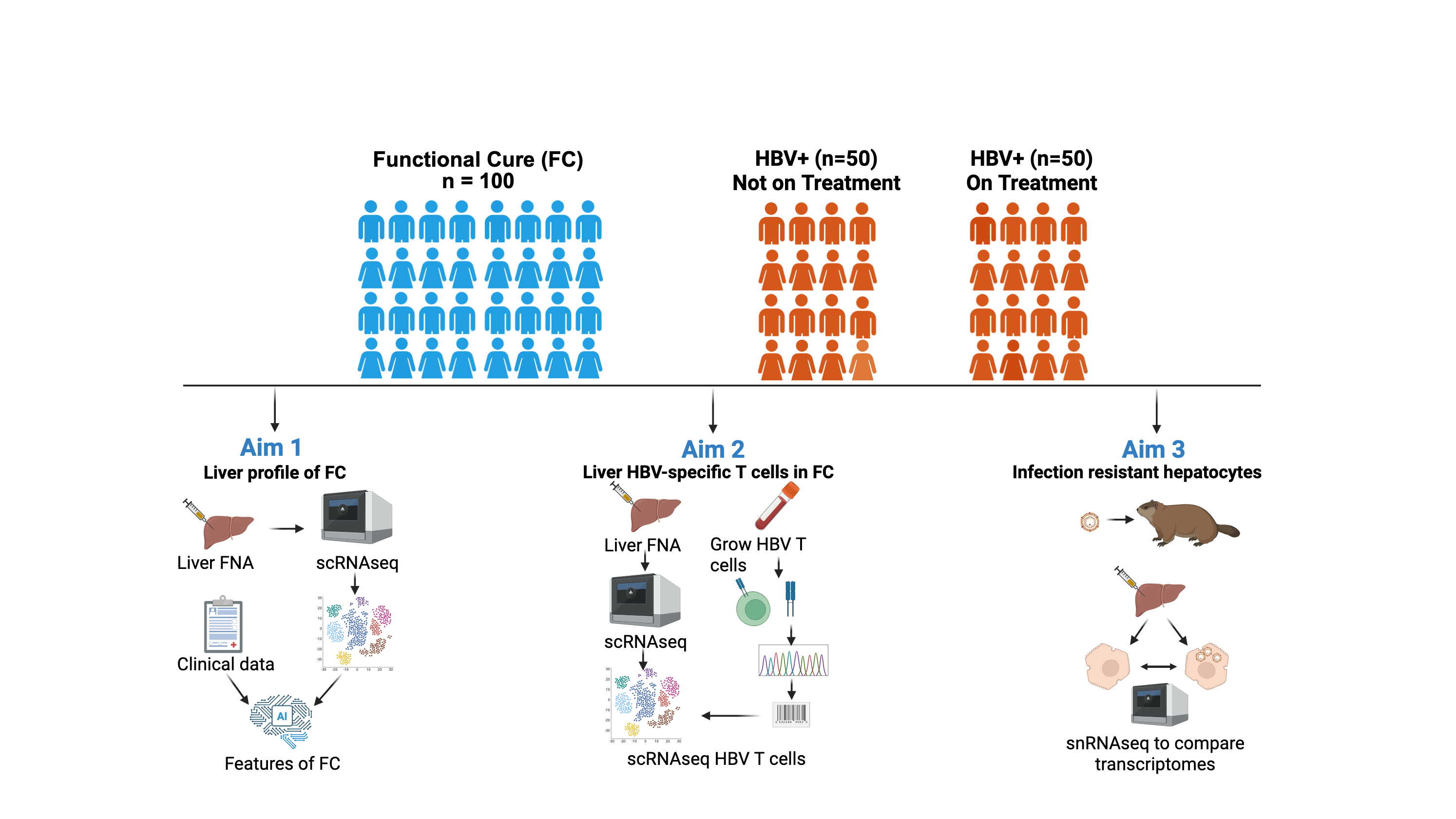
small number of people (one out of every 100 with CHB per year), for unclear reasons, are able to successfully clear the HBV such that it is no longer detectable using clinical tests. These people do not need treatment and have achieved a so called “functional cure”. Expanding functional cure to the other 99% of individuals is urgently needed because it reduces the risk of liver disease and eliminates the need for life-long expensive treatment. In this study, we
will enroll individuals who have achieved a functional cure and compare them to people who still have chronic hepatitis B. We will analyze their blood and liver immune cells for special markers that will help us understand why some (i.e., only 1/100 per year) achieve functional cure. We will combine this data with clinical information and, using standard research methods and artificial intelligence (AI) approaches, find out how the body controls HBV. Finally, we will use liver cells grown in a lab dish, as well as woodchucks infected with a closely related virus (woodchuck hepatitis virus), to understand what factors inside the liver cell can help clear the virus. Identification of these factors can be used to develop improved treatments for hepatitis B. Our team includes experts in hepatitis B, liver and infectious disease specialists, veterinarians, scientists, artificial intelligence experts, patients and community partners that
not only help achieve project goals but have enormous potential to advance understanding and care of HBV infection.
PATHFINDER: PATH ways to F unctional cure in chronic HBV using artificial IN telligence to D efine new E ndpoints in patients who R esolve chronic infection.