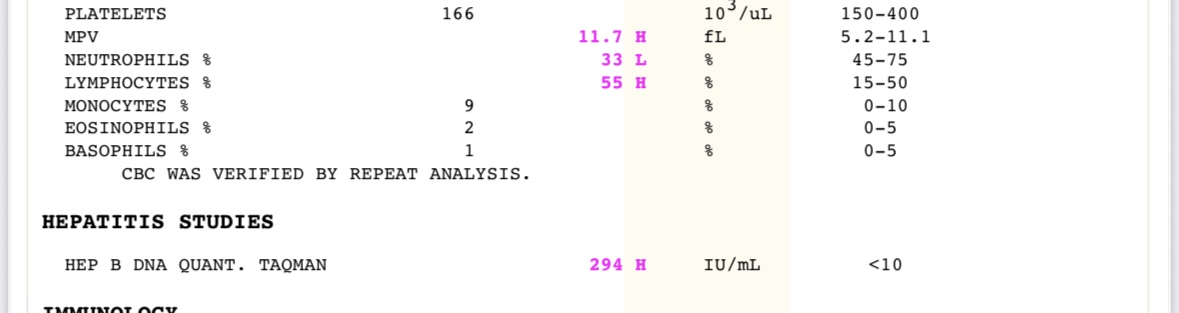
My viral load last year was very low at 49H my most recent results indicate a viral load of 294 H. That’s almost five times higher and I’m afraid about the increase and that it will continue to increase! What could be causing this?
I meet with my general practitioner next week to discuss my results but I’m getting impatient. And then he will refer me to a specialist
Also my WBC was very low and it concerned me…2.9 CL! The range in America is 4.0-11.0 is that normal?!
My AST was also high, at 49H (range is 1-40) but my ALT was in range although slightly on the higher end (it’s 41 whereas the range is 5-45)
I’m very concerned
Edit: per Jon’s reply I would like to state that my viral load reading was 294 iu/ml, the H was just indicating that it’s high. Here is the screenshot of my results that shows the viral load reading and some other readings that appear out of range
I am not a clinician and cannot formally diagnose your condition. However, I can say to the limit of my understanding what these numbers mean.
“49H” and “294H” are not standard units to report HBV DNA levels so I don’t know how to interpret them. Is the H an interpretive statement saying they are high? (In this context it is likely that any detectable HBV DNA would get an “H” as the normal state is to be non-infected.) Are these values actually 49 IU (H) and 294 IU (H)? If so, then the change would mean nothing as both values would be extremely low and the change would reflect normal chatter in the readings. Again-this interpretation is valid only if the numbers are in IU.
Your WBC level is a bit low, but not badly so. Those levels can also fluctuate.
AST/ALT: This is not likely something to worry about as ALT is normal and AST is only slightly elevated. Many things can cause transient rises in liver enzymes, for example having a glass too much wine the night before, eating something with a trace of a toxin in it, etc.
As always, the best person to give advice on specific lab values is your physician. S/He will have access to your full medical history and has been trained to interpret the values. If you remain concerned, I urge you to call your physician.
Hi @john.tavis i greatly appreciate your input. I apologize for the confusion but yes you are correct the reading for my viral load is 294 IU/mL. The H was indeed just indicating high.
I’m glad it is still considered low but I am worried about how much it increased in just a year. I wish I knew why it increased like that. Is it normal for someone with chronic hepatitis b to see increases like that?
@john.tavis here are my results. I also noticed a few other things are out of range aside from what I indicated above but I assume this is just related to my HBV
Also, @john.tavis is the IU/mL reading as seen in my photos I posted to my post that I edited as well as in the screenshot in the reply to you above the same thing as just the IU reading you were referencing?
HBV titers (ie, DNA levels) can get to remarkably high levels, up to around 10^10 IU/ml at the peak of an acute infection. People with HBe+ infections often have values in the 10^5 or 10^6 range (100,000 to 1,000,000 IU/ml). Also for context, the typical threshold for recommending HBV therapy is 2,000 IU/ml, almost 10x higher than your latest reading.
That puts your numbers in context–they are very low! I would not worry about the change between the last 2 numbers unless there is something else that your physician is concerned about. Again, S/He is the best person to answer detailed questions about your labs.
Thank you @john.tavis I appreciate your insight! I was so worried about the increase from last year to this year. It was an almost 5x increase between last year to this year. I’m glad they’re still low values but I hope they don’t continue to raise with time
I honestly don’t remember if I’ve gotten a viral load reading before last year so have nothing else to compare it to. But I have gotten a scan of my liver done and at the time (maybe three to four years ago) there was nothing noteworthy that the doctors saw and no issues were noted so that does make me feel a bit better.
Yes I have an appointment with my general practitioner today actually! It was initially next week to discuss the results but since I was so nervous I called to see if they could squeeze me in today and thankfully they could! I will have him refer me to a specialist, it may be a while though unfortunately sometimes it takes a while to see specialists but hopefully I won’t have to wait too long.
@ScienceExperts@john.tavis I have another question, is it normal that a viral load would increase this much in one year? I’m worried that next year again it will increase a lot more once again.
Please do not worry about this small change in titers–focus on the total value not the fold-change. Viral titers fluctuate depending on a lot of variables, and that can appear as a large fold-change when the starting number is very small. This is what you encountered.
Hello John, how likely is a unit error with hbv dna?
I am either convinced that the viral load fluctuates significantly within short periods of time as my personal circumstance:
End of March - 204 iu/ml (no antiviral)
End of May - 5500 iu/ml (no antiviral)
July 09 - <10 iu/ml (started antiviral June 13)
Or there is a unit error?
How likely is a unit error in a lab setting? Copies/ml vs iu/ml. I think I read the conversion is about 5 times to convert between the 2 units; iu/ml is about 5 times less than copies/ml if i remember correctly. Are labs designed to prevent these types of unit errors?
Unit errors are almost unheard of in clinical lab testing. The legal liability for making such a mistake is huge, so the quality control is very tight.
@john.tavis thank you. I’m trying not to worry but it’s hard not to, especially after seeing someone else’s comment on this thread about how their viral load increased from 200 to 5000 in just a few months! But I will try not to stress and perhaps I should just start getting tested every 6 months going forward to better monitor
I think that’s a great idea to get tested every six months.
That’s what lots of us do. Every six months or three months if there’s a problem.
I’m not a healthcare professional just lived experience 40+years.
With your results I think it is common for them to fluctuate. Yours are not high. When the numbers are in the thousands, can be a problem.
Even if it were in the thousands, there’s treatment-one pill a day. I’m on treatment for last 5 years. And no problems It brought my numbers down quickly. @Bansah1@ThomasTu can you comment please
Yes, as mentioned by many others in this thread, virus levels can change dramatically - particularly when you are not on treatment. Changes of this magnitude are expected, and what is important is the ongoing pattern in these such instances.
Thank you @Caraline I appreciate the input! I will definitely get tested every six months, and I assume my Hematologist will recommend doing so once I see him, and my wife wants me to as well so I think it will be good.
Were you ever on treatment at any other point in your life or was the last five years the only time you had to get on treatment?
@Caraline thank you for the input! That’s great to hear that you were able to go so long without treatment. I’m curious to know, once someone goes on treatment is it lifelong? Or is there a chance that they could eventually go off treatment?
I’m wondering if I ever end up on treatment, which I feel like I likely eventually will, I imagine most chronic carriers likely end up on it, but that’s just an assumption I’m not sure if that’s even true, if it will be lifelong or if some patients are able to eventually get off of it.
Treatment may be lifelong, but not always. I first started treatment in 2014, when I was HBeAg+, and my viral load was very high. Then, after a year on the antivirals, I seroconverted to HBeAg-
I stayed on the antivirals a little longer, and the seroconversion persisted, so my doctor told me I could stop taking the medication. Many experts consider this a reasonable endpoint of treatment. This article explains it better.
Anyways, I was off of treatment for 5 years, but then my HBV DNA and ALT started going up again. When that happened, I ended up going back on treatment. But some people can stop treatment after HBeAg seroconversion and have low viral load, without ALT flares. It all depends, but it is important to be monitored whether you’re on medication or not.
I’m not an expert but my understanding is -it’s for life.
I don’t have a problem with that.
In the beginning of my treatment I didn’t like the fact of taking it for life. But then I thought of the benefits and also other people with other illnesses besides HBV and thought, I’m very blessed to be able to have access to medicine.
Others will help answer you some. @Bansah1@ThomasTu