B-Definite: new GSK phase 4 bepirovirsen study for HBsAg ≤100 (no placebo, starts 2027)

Another option worth knowing about, especially for those of you in countries where Hibsago isn’t on the market yet (which right now is everywhere except the US and Japan).

GSK has registered a phase 4 study of bepirovirsen called B-Definite (GSK study ID 316846). It’s single-arm and open-label: no placebo, everyone enrolled gets bepirovirsen 300 mg weekly for 24 weeks on top of their NA, then stops the NA per protocol and is followed to week 72 for functional cure. Status is “not yet recruiting”, planned start February 2027, running to February 2029. No sites are posted yet, so keep an eye on the register and ask your hepatologist to do the same.

Why this one matters: it targets the group that did best in B-Well. Entry requires HBsAg ≤100 IU/mL, which is far below the ≤3,000 label cutoff. In the phase 3 trials the functional cure rate climbed as baseline HBsAg fell (around 25 to 28% under 1,000, and higher still in the lowest strata), so people at ≤100 are the ones with the best odds this drug has shown anywhere. If you’ve been on Vemlidy or entecavir for years and your HBsAg has drifted down into double digits, this is the study designed for you.

Other key criteria: 18+, chronic HBV for 6+ months, stable NA (entecavir, TAF or TDF) for at least 6 months, HBV DNA <90 IU/mL, ALT ≤2x ULN, no cirrhosis (APRI, FibroTest, F4 biopsy or stiffness ≥12 kPa all exclude), no HCV/HDV/HIV co-infection, no interferon in the past 12 months, no immunosuppressants in the past 3 months, no anticoagulants or antiplatelets unless they can be stopped, and willing to stop your NA when the protocol says so.

And yes, same catch as every other study in this space: no prior bepirovirsen. So this is for the bepi-naive. For those of us who already had a course, nothing changes, but for everyone else in Europe, Asia or elsewhere waiting on a local approval, this is a way to get the approved drug, with the monitoring paid for, a year or two before your health system gets around to reimbursing it.

If anyone sees sites listed for B-Definite, please post the countries here.
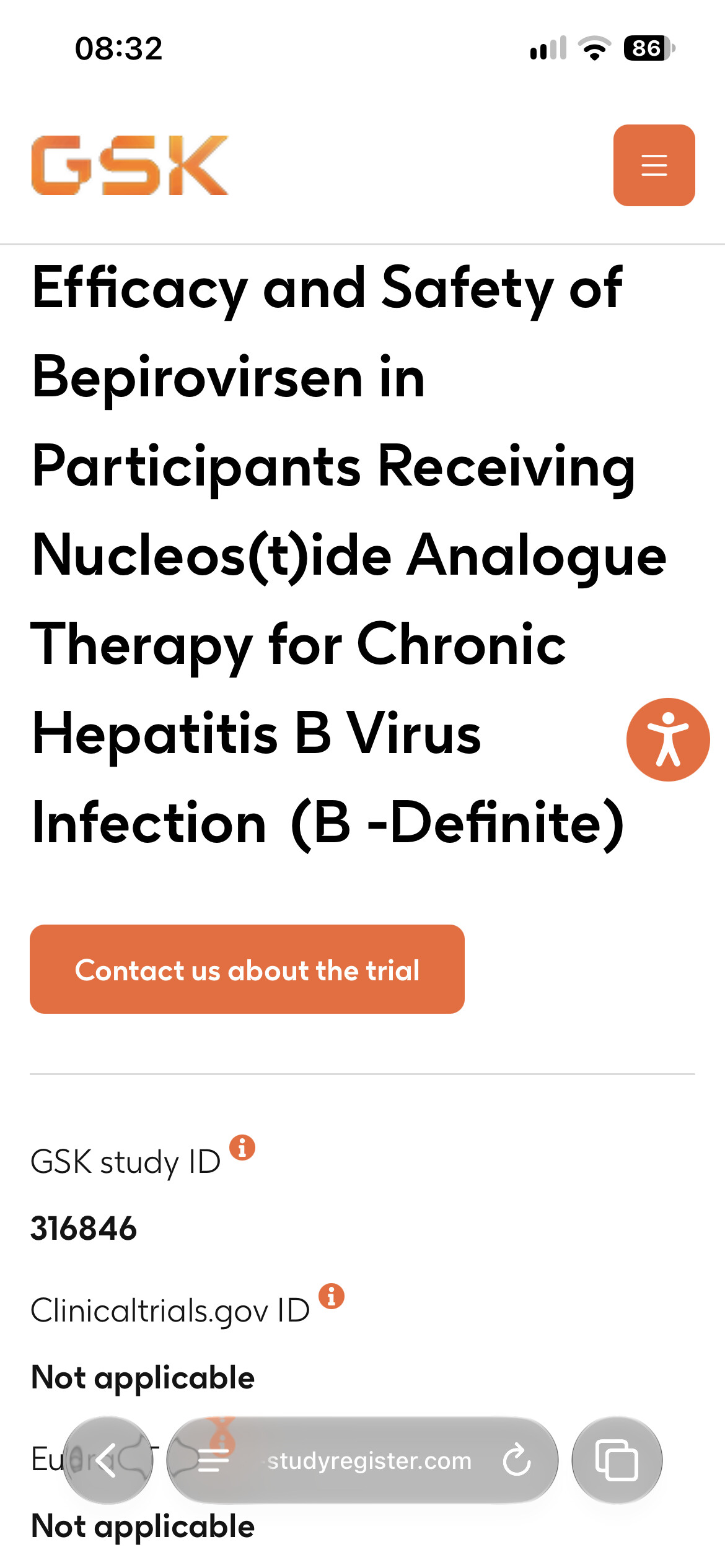
GSKTrial ID 316846

4 Likes

Thank you so much for sharing this! I would absolutely love to participate, especially since I’m expecting a ton of hurdles from my insurance. Joining a trial would be an amazing way to bypass the financial burden and all that insurance wrangling. My HBsAg is actually <1, so it seems like a perfect fit! I’ve never participated in a clinical trial before, though. Do you know how the process usually works? Does my doctor need to formally refer me? I’d love to know if there is any prep work I can do now so I’m completely ready once it opens for recruiting.

1 Like

Less than 1 is great. Do you take any medicine?

With your HBsAg below 1 IU/mL, you could be a particularly interesting candidate for GSK’s upcoming B-Definite trial! You’re almost a unicorn in terms of how low your HBsAg is, although you would still need to meet the other eligibility criteria.

Here’s what I would recommend:

  1. Contact GSK directly through their study page. There’s an orange button labelled “Contact us about the trial” at the top. Click it and explain that you have chronic hepatitis B, your HBsAg is below 1 IU/mL, and you’re extremely motivated to participate. Ask when recruitment will begin, which hospitals will participate, and whether you can be considered for prescreening.
  2. Check the study page weekly or at least monthly. GSK should publish updates as the trial progresses, particularly recruitment status, participating locations, and contact information.
  3. Make your hepatologist aware of the study now. Tell your doctor that you’re very interested in participating and would appreciate their support with the enrollment process. They may also be able to contact the study investigators directly.
  4. Prepare your medical records, especially your quantitative HBsAg, HBV DNA, ALT, liver fibrosis assessment, and antiviral treatment history.
  5. Highlight your unusually low HBsAg and strong motivation. Your HBsAg level is well below the study’s published threshold of 100 IU/mL, which is encouraging. However, you must also meet the other requirements, including stable antiviral treatment and no previous bepirovirsen exposure.

The trial is currently expected to start in February 2027, so this is a good time to establish contact.

Official GSK study page:

Once you open the page, simply tap “Contact us about the trial” to reach GSK’s study enquiry channel.

I would definitely pursue this opportunity. Your HBsAg level is unusually low, and being proactive now could help you get in touch with the right people before recruitment starts.

Wishing you the best of luck!

Thank you for sharing. How can people from Africa get access?

Not the GSK one, but others:

1. South Africa — B-FOCUS

This Phase 2 trial investigates bepirovirsen in people with both HIV and chronic hepatitis B, already receiving antiretroviral treatment.

GSK lists South Africa among participating countries. However, the sponsor’s recruiting label conflicts with a newer registry-derived overall status, so I would not assume that Johannesburg, Ekurhuleni or Durban are accepting new participants. gskclinicaltrialskiosk.com

B-FOCUS — ClinicalTrials.gov

2. South Africa — B-UNITED

This is particularly interesting scientifically because it combines siRNA therapy (daplusiran/tomligisiran) followed by bepirovirsen, an antisense oligonucleotide.

It accepts patients receiving background nucleos(t)ide analogue therapy.

However, the study has already enrolled its planned 283 participants and is classified as active, not recruiting. South African sites are listed, but they are not confirmed open for new enrollment. ICHGCP

B-UNITED — GSK official study page

3. Tanzania — TherVacB

This is the most interesting African location to monitor for an upcoming opportunity.

The therapeutic vaccine trial plans to include:

National Institute for Medical Research — Mbeya Medical Research Centre, Tanzania.

The official TherVacB website identifies Mbeya as a future participating centre, not among its six currently recruiting centres. Recruitment timing in Tanzania has not been confirmed. TherVacB project

TherVacB — Official recruitment information

4. Ethiopia — Active HBV study

Addis Ababa University has a recruiting study evaluating improvements in hepatitis B care delivery.

Public contact:

This is not a gene-editing, siRNA or therapeutic-vaccine trial. ClinicalTrials.gov

Ethiopia study — NCT06586983