Companies like Precision Biosciences, nChroma and Tune claim that they can inactivate integrated HBV DNA (iHBV DNA). All of these companies use similar approaches which attempt to target the disruption of integrated HBV DNA by approaches with require the recognition of specific nucleotide sequences located only in iHBV DNA.
However, these companies have failed to disclose the following:
Just like cccDNA, integrated HBV DNA exists as a pool of genetically diverse species. Single nucleotide mismatches between the targeted recognition sequence and the actual sequence present block this activity. In addition because HBV is so genetically plastic, these escape sequences will become enriched in cccDNA and newly intergated HBV DNA pool rapidly under the selection pressure of any of these approaches.
All of these approached use LIP-encapsuslated mRNA (just like some of the vaccines used for SARS CoV2). This approach is known to stimulate a strong stimulation of innate immunity in the liver. Similar to GalNAc-siRNA.
Inactivating iHBV DNA means to disrupt its activity without excising it from the host chromosome.
If possible, this inactivation would be permanent. However, reactivation of cccDNA will always be possible anyways so this is a moot point.
The only means by iHBV DNA can be removed from the liver is the recognition of and destruction of cells harboring iHBV DNA by host immune functions. Efficient elimination of HBsAg (SVP) by NAPs allows removal of integrated HBV DNA by the host immune response in the majority of patients (56%). This confirmed by the maintenance of HBsAg loss after removal of therapy for 5+ years. Some newer approaches using HBsAg-directed T-cells appear to have achieved this (we need much longer follow-up to be sure in these studies). However, in this case, only a small fraction of the patient population globally is immunologically compatible with this approach and even within this small fraction, success was only achieved in a minority of patients which did not have a large HBsAg load before treatment.
Low baseline HBsAg is anything < 1000 IU/mL. Functional cure is rarely seen with baseline HBsAg above this level with pegIFN or therapies in development other than NAPs.
Average baseline HBsAg globally is~10,000 IU/mL but levels can be much higher (> 100,000 IU/mL)
Dear dr. @availlant , I’d like to thank you once again for your generosity in providing us with robust information about our comorbidity. This allowed me to be more proactive with my doctor and adhere to the treatment guidelines available in my country (Brazil). Treatment is free here, and they’re providing me with TDF. They reexamined my liver biopsy and found grade 2 fibrosis, even though my liver function tests were normal. I have HBEAG - and had 55.000 IU/ml HBV/DNA in May.
In this sense, I feel more relieved to start treatment early, even knowing that this doesn’t completely eliminate the chance of liver disease progression. And at this point, I have a question: even during treatment, there’s a risk of progression to HCC… but is this progressive? With the appearance of fibrosis or cysts? Or can it be more “instantaneous”? Does it follow a pattern of progression for these clinical conditions?
Starting your TDF therapy will halt and may even help very slowly reverse your liver fibrosis.
Integration of HBV DNA begins after infection as soon as the cells in the liver begins to produce new infectious virus. These integration events continually occur and build up over time.
NUC therapy (such as TDF) suppresses the production of infectious virus and as such also suppresses new integration events. However, the longer the delay in starting NUC therapy after infection, the more integration builds up in the liver. Since NUC therapy cannot effect integrated HBV DNA, the risk of HCC remains increased relative to the extent of integration which occurred before NUC therapy started.
For most people, NUC therapy does lower the risk of HCC.
Can u tell me why hbsag fluctuate .. like every time i go for a routine test like after every 3 months my hbsag values is either 200-300 iu/ml up or down.. but it stays in a range of 1500-2500 only..!! What does this type of fluctuations tell..!
HBsAg fluctuations are normal. They likely represent mild fluctuations the speed of HBsAg release from infected cells or alterations in reactivity to the host immune response. There is no clinical significance to these fluctuations.
Why dr are more focus on hbv dna values but not on hbsag values?? Will iDNA stop damaging liver after antivirals?? Bcz i have read in the forum that 90% of the people dont know their hbsag values they only know about the status..that they are negative or positive..!!
HBV DNA levels are important because they indicate how aggressive your infection is and your response to antiviral therapy. These factors are important to assess the need for antiviral therapy under current guidelines and to monitor your response to therapy.
HBsAg levels do not provide any of this diagnostic information. In additional, there is no approved therapy for lowering HBsAg and in the case of functional cure, only undetectable HBsAg matters.
Laboratories don’t offer quantitative HBV DNA testing in my country. They only provide qualitative results. So, to clarify my condition, is there any relationship between the amount of HBSAG and HBV DNA? Can a patient who has always had low HBV DNA and then exceeded the threshold and started treatment have a high HBSAG level? Or is there no correlation between these numbers?
Because HBsAg is produced by a different mechanism than virus and is also produced from integrated HBV DNA (which does not produce virus) there is generally no correlation between HBV DNA and HBsAg.
That being said, HBsAg levels tend to be higher during the early stages (HBeAg positive) of chronic infection.
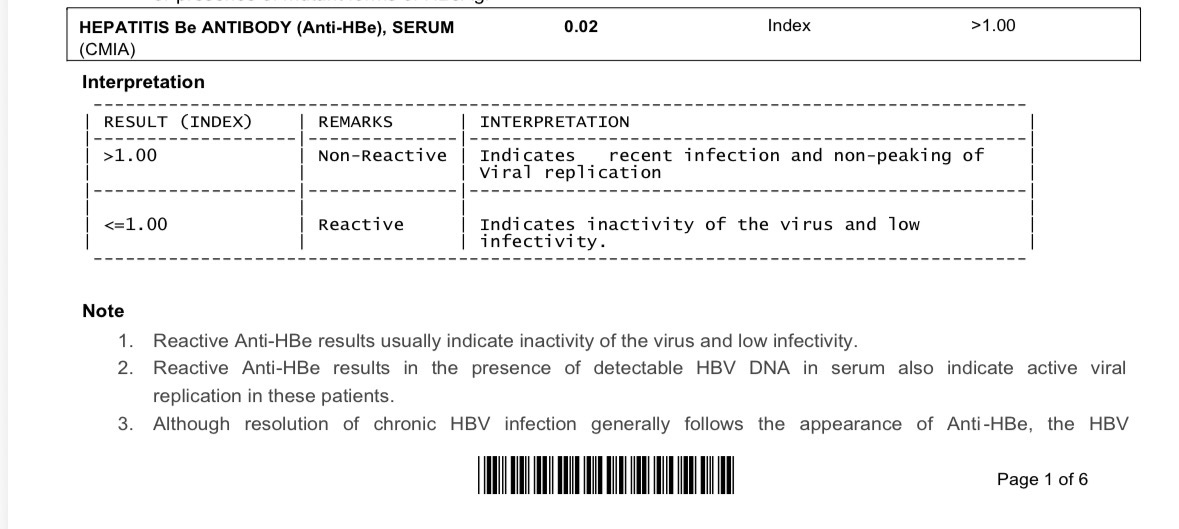
If we have hbsag 2500 and viral load is low around 800 hbeag negative and hbeab positive ..waht does it mean??? Is virus more dangerous and replicating…?
My understanding is that 6.4kpa is still within normal levels. Fibroscan scores can vary depending on many things including the person conducting the test. If you are on TAF with undetectable viral loads, the liver damage progression caused by HBV is generally minimal.
Thomas
Thank u so much @ThomasTu i was worried bcoz my median reduces from 345 to 308 and kpa score increase from 5.6 to 6.4.. i was worried about this..! Why this happening..??