Hello, I have an HBs antigen level of 50000 IU. If I take bepivorisen, it could decrease it. Which would be good. Is the decrease lasting? And can they prolong the treatment until the HBs antigen disappears? They don’t mention cases with a high HBs antigen level because I don’t think it’s been tested. Do you have any information on this subject? Thanks in advance.
Hi @Marie_David,
They didn’t test it among patients with higher surface antigen levels. The clinical trials were conducted among individuals with surface antigen levels of 1000 and 3000. Bepi was most effective in the 1000 group. They may look to make improvements and test it among patients with higher surface antigen levels down the road. Not all hepatitis B patients will benefit from Bepi in its current form. Best, Bansah1
1 Like
@Bansah1 they actually did test it in higher HBsAg patients in the phase 2 trials, and it was not shown to be effective, so that’s why the phase 3 trials excluded those patients.
I believe what happened is that the HBsAg declines started to plateau after taking Bepi for several months, so there’s no guarantee that long-term treatment would cause levels to continue to go down.
2 Likes
Hello, I read that bepivorisen (bepivorisen) would be available in French hospitals in 2031, which seems like a very long time. Does anyone have any information on this? Thanks in advance.
Hi everyone,
I’ve been following the recent discussion about bepirovirsen and the NYT article, and I’m really curious how this might apply to patients like me.
I have chronic HBV but have never been on antiviral treatment. My profile is:
- HBeAg negative
- anti-HBe positive
- HBV DNA consistently very low (around 79–216 IU/mL)
- HBsAg around 900 IU/mL
From what I understand, most of the phase 3 trials included patients who were already on antiviral treatment.
So my question is:
What about people who are not on treatment but already have low viral load and relatively low HBsAg levels?
If bepirovirsen gets approved, do you think:
- It will only be used in patients already on antiviral therapy first?
- Or could it eventually be considered for patients like me without prior NA treatment?
Also, given that lower baseline HBsAg seems to correlate with better response, would patients with profiles like mine potentially be good candidates in the future?
I’d really appreciate hearing thoughts from anyone more familiar with the trial design or upcoming treatment guidelines.
Thanks!
2 Likes
Hi @Maja,
They did test bepirovirsen in patients not on antiviral treatment in the phase 2 studies. I’ve attached some of the results from that study from the cohort not on antiviral treatment.
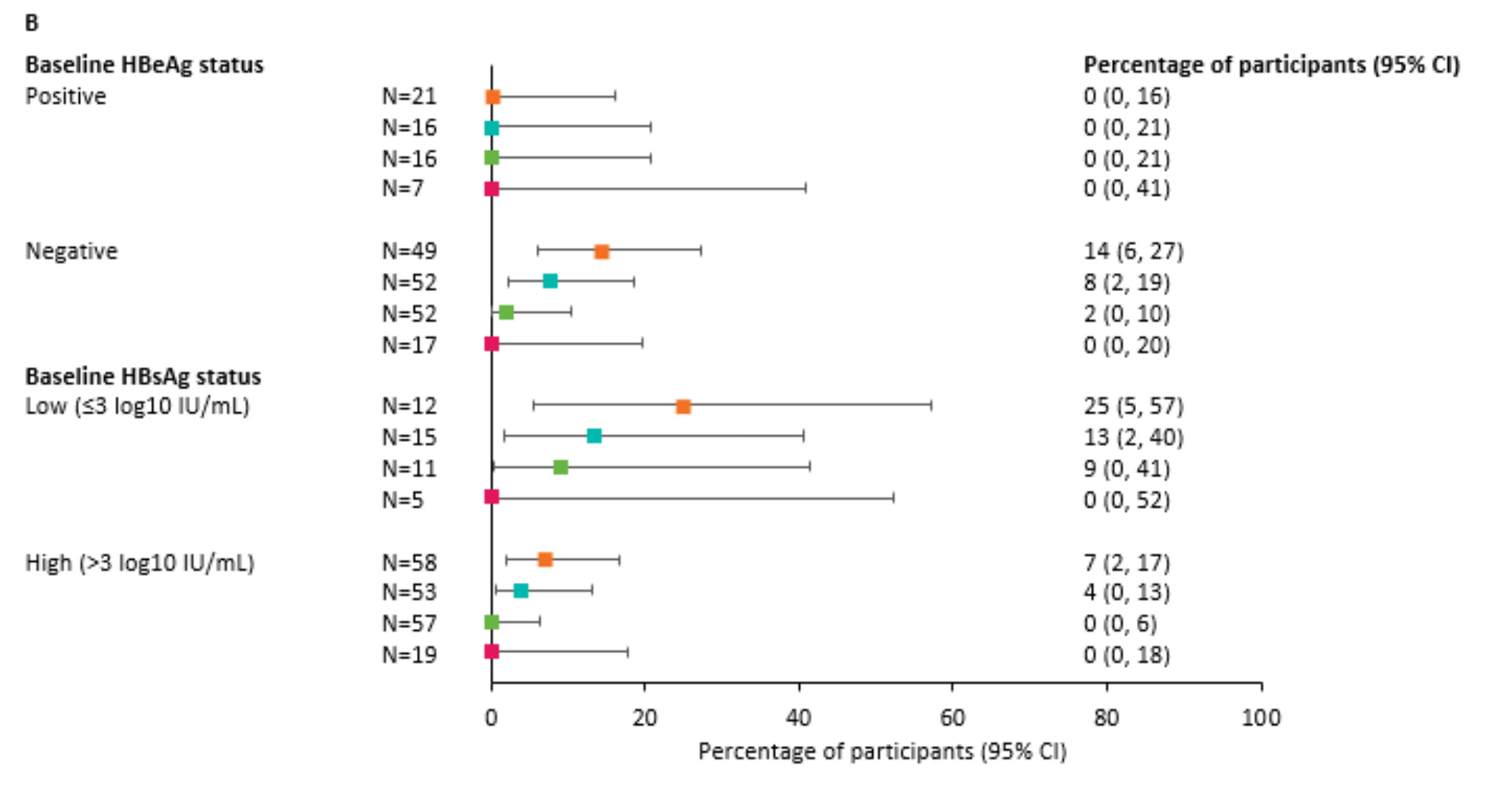
The functional cure rate for HBeAg-negative patients with low baseline HBsAg is actually comparable to the numbers for patients who are on antiviral treatment, so I would say that there’s still a chance that it could work. Whether or not you’ll be able to get on it probably depends on whether health insurance requires you to be on antiviral therapy first.
I figure they probably required people to be on antiviral therapy for the phase 3 trials, just to remove one more possible confounding variable.
One thing that I will point out, since I recall from one of your other posts that you’re currently pregnant: bepirovirsen was not tested in pregnant or breastfeeding patients, so it’s highly unlikely that any doctor would prescribe it to you until you’ve stopped breastfeeding your baby. They would also want to make sure you don’t want any more kids for at least 1 year (maybe longer) when you start it. In the clinical trials, they required people to use 2 forms of birth control to prevent pregnancy (e.g. the female partner using hormonal birth control, plus the male partner also using a condom).
4 Likes
Hi @et5656
Thank you so much for sharing this, it’s really helpful to see those results for patients not on antiviral treatment.
That said, your point about pregnancy and breastfeeding is very important. I understand why it would likely not be an option for me at this stage, and I appreciate you highlighting the precautions from the clinical trials as well.
It does give me some hope for the future though 
Best,
Maja
3 Likes
How come nobody is talking about AHB-137 results. I feel like these look even better than Bepi. Am I missing something? From what I read this study was for patients not on NA. But 70% FC rate up to 1000 hbsag and also this…
“Among the 19 participants with baseline HBsAg at or below 3000 IU/mL, 84% (16 of 19) achieved HBsAg loss by EOT. All 6 participants with baseline HBsAg above 3000 IU/mL demonstrated reductions of at least 4.5 log10 IU/mL, with 3 of those 6 achieving outright HBsAg loss. In total, 68% of participants (17 of 25) achieved CR at EOT.”
Seems promising. Thoughts?
2 Likes
@Mike2 This topic came up specifically because there was a presentation about bepirovirsen at the EASL Congress. It’s a big international conference for liver disease, so understandably it’s creating a lot of buzz. The drug has also wrapped phase 3 trials, and has been submitted to the FDA for review. It’s the first HBV drug that has reached this stage of the pipeline in more than a decade. Sometimes being the first equates to getting the most attention.
No I absolutely get it. Trust me. But these results for AHB-137 were also presented at EASL. I just feel they were overlooked. Maybe because GSK has a 103B market capitalization and Ausper Bio is under 300M has something to do with PR. 
But thank you for sending the article about AHB-137! I have access to the posters from EASL. Bepirovirsen was presented in one of the general sessions, which more people tend to attend compared to the poster presentations, which are much shorter. People typically only look at posters if they’re interested in the specific topic being presented, but people from multiple areas of hepatology, gastroenterology and public health usually attend the general sessions.
2 Likes
Okay yes, I think you’re right that the name recognition of Big Pharma companies like GSK also has something to do with it
1 Like
Thanks for claryfing. I just find these results pretty groundbreaking for the AHB-137 not on NA. Also interested in the study they did with the mice where a vaccine gets administered after AHB-137 didnt lead to Hbsag rebound. Its in the article at the end.
1 Like
Exciting news! I don’t know if there is a standard on sample size. But It seems that the number of participants of this experiment is limited.
3 Likes
@sunfeng there isn’t really a standard, but generally earlier stage trials have fewer people, and then later in the process, they start recruiting more people. Some rough numbers from other hep B clinical trials I’ve seen advertised:
- Phase 1A (first in human): ~10 people
- Phase 1B/2A: ~25-50 people
- Phase 2B: 100-500 people
- Phase 3: 1000+ people
Clinical trials for other diseases may have different sample sizes. For example, it’s much harder to recruit patients for hepatitis delta trials, because it’s much less common than hep B, and testing is limited, so there would be fewer people in each phase of the trial.
2 Likes
@sunfeng Bepi cure rate is high for East Asian (or Chinese) if I remembered correctly. And the AHB-137 is developed in China.
2 Likes